
Increasing AI-related cross-border investment bucks the global trend. Focus on building resilient supply chains in Asia
3 min read
Cross-border investment in artificial intelligence (AI) projects and infrastructure is bucking the global downturn, and Asia is becoming a hub for AI development and investment.
Artificial intelligence (AI) is bucking the trend when it comes to the global slowdown in cross-border investment. A mix of geopolitical tensions, fragmenting supply chains, and economic concerns are negatively impacting international investment. But AI is still drawing significant investment.
The growth of large language models (LLMs), the boom in generative AI use, the expansion of data centers designed for AI processing, and surging demand for advanced semiconductors mean that AI is significantly outperforming other sectors. Put simply, demand for AI processing power is outstripping supply.
AI – Beating the Odds
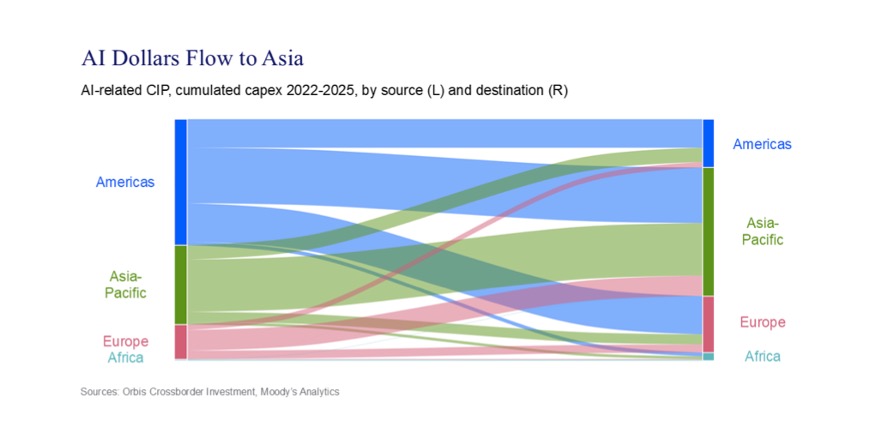
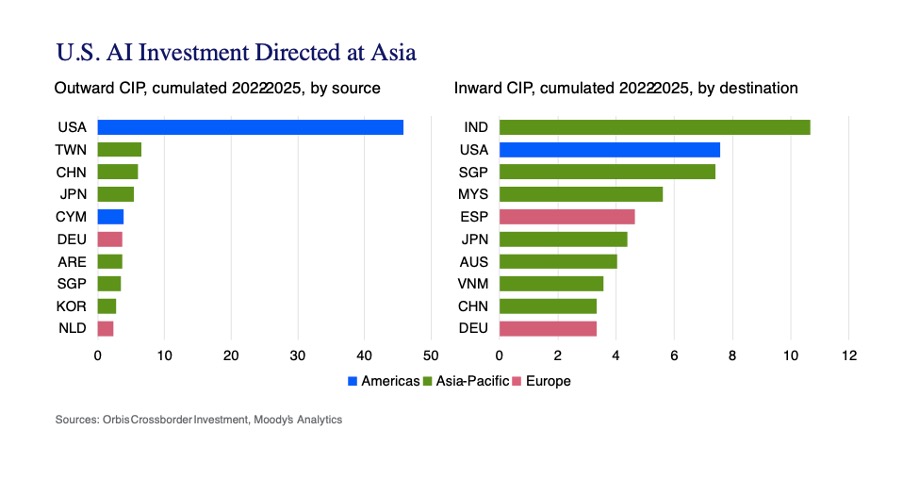
According to a report from Moody’s Analytics, titled “AI is Beating the Odds”, Asia, in particular, is reaping the rewards. India was the top recipient of investment for data center and chip manufacturing, according to the report, attracting over $10 billion in funding since 2022, with Singapore and Malaysia also benefitting from data center projects. But Japan, Vietnam, Australia, and Malaysia are also noted as significant recipients of foreign investment in AI.
The U.S. is the largest source of AI-related funding in the region, investing $45 billion. Other major sources of AI funding include Taiwan, China, Japan, and Germany. This outward-facing investment is aimed at creating a more resilient global supply chain with risk not concentrated in a single location, while taking advantage of the benefits offered by recipient countries.
These include a deep and growing digital talent pool, expanding data center capacity, strong policy incentives, and lower operating and labor costs. Figure 1 highlights the flow of AI-related investment into, and out of, Asia.
Figure 1. AI investment flow to and from Asia
The U.S. remains a prominent global AI player
The report reveals two significant trends. First, the 2022 release of OpenAI’s ground-breaking ChatGPT app has driven a huge boom in AI investment since its launch. The rapidity and popularity of the app has accelerated investment in AI technologies, alongside the growth of LLMs, growing demand for AI processing power located nearer to the user, and enterprise applications such as digital twins.
The second trend is the prominence that the U.S. has taken as both a source and destination of AI-related foreign investment (the largest source, and second largest recipient after India). Multinational technology companies such as Google, Meta, Microsoft, X, OpenAI, and Anthropic are leading the way when it comes to the development of LLMs, and Asia is seen as a cost-effective platform for developing and extending those models (see Figure 2).
Figure 2. U.S. AI-related investment in Asia
Southeast is a rapidly developing hub for AI
Asia is becoming a hub for AI development, supported by significant growth in data centers and semiconductor fabrication capabilities. For U.S. companies it represents an excellent opportunity in light of the on-going geo-political, and economic, tensions between the U.S. and China.
Pamir has decades of experience of helping U.S. companies navigate through the myriad challenges that Southeast Asia brings. To find out more about AI-related investment and development in data centers in Southeast Asia, download our paper here.
To talk to us about the unique services we offer to U.S. companies looking to minimize risk and optimize opportunity in the region, contact us today.

Screening Is Not Enough: Mapping Supply Chains in China’s Military-Civil Fusion Landscape

Leader of Taiwan’s Opposition Concludes Two-Week Visit to the United States