
China and the U.S. sign a deal to accelerate the import of rare earth elements (REEs)
3 min read
In April, as a response to significant U.S. import tariffs, Beijing placed export restrictions on seven essential REEs, which are used in clean energy, military, aerospace, semiconductor, and automotive applications. But since then, the two countries have announced a deal to ease trade tensions, including REE exports.
On July 26, 2025, the U.S. and China announced that the two countries had reached a deal to accelerate the import of rare earth elements (REEs) and the magnets they are used in, into the U.S. from China. REEs and magnets are essential for, among other things, use in military and aerospace, clean energy, automotive, and semiconductor applications.
The announcement, announced after talks in London between senior officials from both countries, follows an initial meeting in Geneva in May 2025, which laid the groundwork for such an agreement and included plans for the U.S. to cut Chinese import tariffs down from triple-digit figures. A further part of the deal involves China processing export licenses for REEs more efficiently.
China has a monopoly on the mining and production of rare earth materials
The agreement is seen as a clear attempt to ease trade tensions between the two nations, and addresses concerns around supply chain disruptions caused by China and REE shortages in the U.S. The agreement will be implemented once it is approved by President Trump and Chinese leader Xi Jinping.
China has used its REE supply chain dominance as a weapon to fight back against U.S. tariffs – it accounts for 70% of global rare earth extraction and 90% of rare earth processing and is the only large-scale producer of heavy REEs, which are less abundant but critical for advanced technologies, including advanced magnets used in electric vehicles and defense applications (see Figure 1)[1].
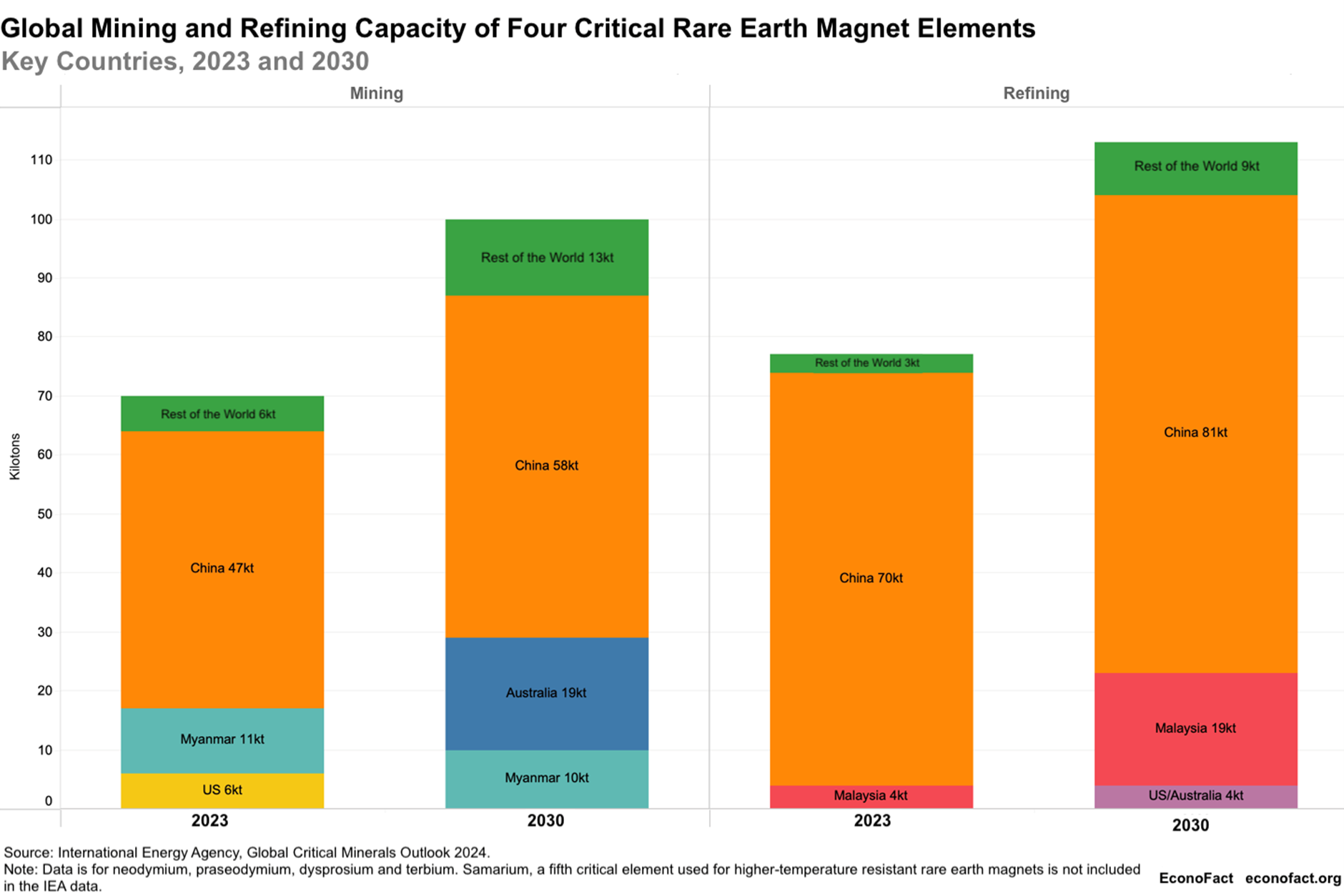
Source: Internation Energy Agency
China’s tit-for-tat manipulation of REE and magnet exports has led to reports of factories in the U.S. being severely affected – a Ford executive reported in June that the company was living “hand to mouth” as a result of the shortages[2]2.
Due to their importance in technological applications, and China’s dominance of the supply chain, REEs have become a key area of contention in the trade tensions between the U.S. and China.
On April 4, 2024, China responded to U.S. tariffs, which at the time were 145% on certain imports, and up to 245% on other products, by placing export restrictions on seven REEs – samarium, gadolinium, terbium, dysprosium, lutetium, scandium, and yttrium – severely restricting some U.S. defense and aerospace companies’ ability to operate (see blog ‘Additional restrictions on the export of rare earth elements from China increases pressure on a U.S.-Ukraine critical minerals deal’).
A diversified, or domestic, REE supply chain?
This has led the U.S. to make attempts to diversify its supply chain for REEs, including a deal with Ukraine to secure supplies of some in this category: the Ukraine–United States Mineral Resources Agreement, signed on April 30, 2025. Other locations for potential U.S. imports of REEs include Australia, Myanmar, Kazakhstan, Nigeria, and Thailand, but output from these and other countries is relatively low.
The REE sector in the U.S. has received $450 million from Defense Production Act appropriations aimed at building domestic processing and refining capacity. However, the process is slow, as the average time for the development of new mines in the U.S. is estimated at 29 years – the world’s second longest[3]3.
It is hoped that the recent attempt to de-escalate trade tensions between the U.S. and China will ease the situation. However, in the longer term, the former needs to diversify its global supply chain for REEs. Meanwhile, it needs to build out domestic capacity.
What are the risks to your business? Do you have a strategy for securing the supplies your business needs? To understand the implications and to position for the future, our experts can help. Get in touch to explore your options.
[1] https://www.oxfordenergy.org/publications/chinas-rare-earths-dominance-and-policy-responses
2 https://www.theguardian.com/business/2025/jun/27/us-china-rare-earth-shipments-deal
3https://cdn.ihsmarkit.com/www/pdf/0724/SPGlobal_NMA_DevelopmentTimesUSinPerspective_June_2024.pdf

Screening Is Not Enough: Mapping Supply Chains in China’s Military-Civil Fusion Landscape
Leader of Taiwan’s Opposition Concludes Two-Week Visit to the United States